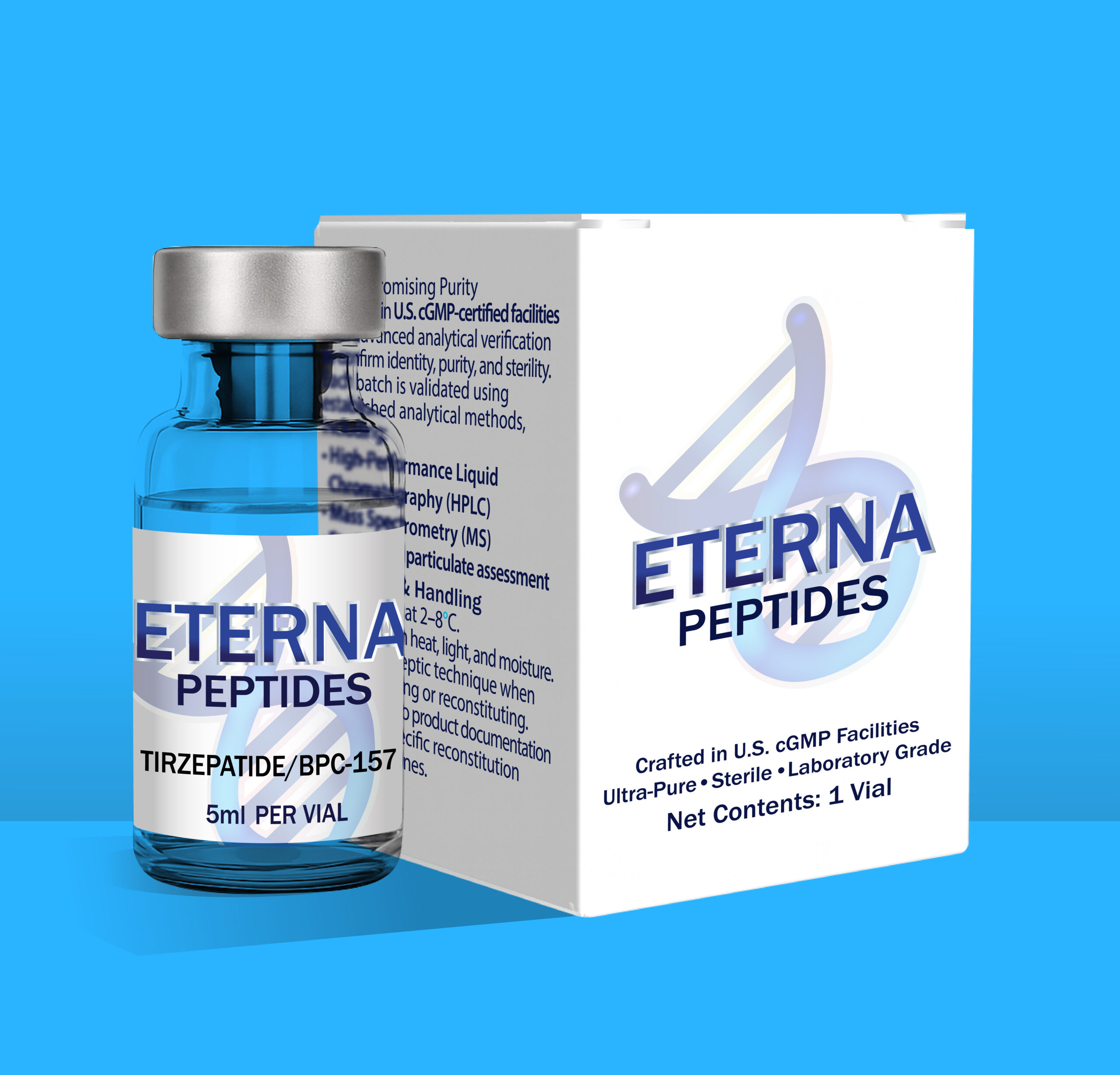
This dossier summarizes a research‑only co‑administration concept pairing tirzepatide, an approved dual incretin receptor agonist (GIPR/GLP‑1R), with BPC‑157, a research‑grade pentadecapeptide investigated for cytoprotective and tissue‑healing effects. The intent is to provide neutral background on each compound, basic identifiers, a combined physiological rationale, and safety considerations. No clinical claim is implied for the combination.
Chemical Structure / Identifiers — Tirzepatide
| Property |
Detail |
| Class/Targets |
Dual agonist at GIP and GLP‑1 receptors |
| Backbone/Design |
39‑aa peptide; Lys‑linked C20 fatty‑diacid for half‑life extension via albumin binding |
| Molecular Formula |
C225H348N48O68 (PubChem) |
| Approx. Molecular Weight |
≈ 4.9 kDa (varies with salt/hydration) |
| CAS Number |
2023788‑19‑2 |
| PubChem CID |
156588324 |
| Indications (context) |
Type 2 diabetes; chronic weight management; moderate‑to‑severe OSA in adults with obesity (per 2024/2025 U.S. labeling) |
Chemical Structure / Identifiers — BPC‑157
| Property |
Detail |
| Sequence |
Gly‑Glu‑Pro‑Pro‑Pro‑Gly‑Lys‑Pro‑Ala‑Asp‑Asp‑Ala‑Gly‑Leu‑Val (15 aa) |
| Molecular Formula |
C62H98N16O22 |
| Molecular Weight |
≈ 1419.55 g/mol |
| CAS Number |
137525‑51‑0 |
| PubChem CID |
9941957 |
| Synonyms |
Body Protection Compound‑157; PL 14736; bepecin (research name) |
Primary Research Focus
• Tirzepatide: appetite/energy intake reduction; glucose‑dependent insulin secretion; suppression of glucagon; slowed gastric emptying; clinically meaningful weight loss and glycemic control in SURMOUNT and SURPASS programs; OSA improvements in two phase 3 trials.
• BPC‑157: preclinical cytoprotective and pro‑healing effects across gastrointestinal mucosa, tendon/ligament, and skin; reports of angiogenesis support and anti‑inflammatory signaling; limited human data and no major‑regulator approvals.
Combined Rationale (Research Context)
• Domain complementarity: tirzepatide addresses metabolic drivers (weight, glycemia, cardiometabolic risk), while BPC‑157 is investigated for tissue repair and mucosal protection in animal models.
• Hypothesis only: there is no established evidence that co‑administration confers additive clinical benefit. Any synergy is speculative and model‑dependent; rigorous human studies are lacking.
• Practical considerations: distinct pharmacology and delivery (approved tirzepatide injections vs research‑grade peptide) complicate combined use; quality and identity of research peptides must be verified for laboratory work.
Safety / Limitations
• Tirzepatide: class‑typical GI adverse events (nausea, vomiting, diarrhea, constipation) during titration; boxed warning for thyroid C‑cell tumors in rodents; contraindicated with personal/family history of MTC or MEN2; pancreatitis reported with incretin‑based therapies; gallbladder disease risk; retinopathy considerations with rapid glycemic improvement; not indicated for type 1 diabetes or DKA.
• BPC‑157: not FDA‑approved; primarily preclinical evidence; limited peer‑reviewed randomized human data; potential variability in product identity/purity across sources.
• Combined use: investigational; safety and efficacy for any clinical purpose have not been established.
Key Publications / References
PubChem Compound Summary: Tirzepatide (CID 156588324). https://pubchem.ncbi.nlm.nih.gov/compound/156588324
NEJM (2021) SURPASS‑2: Tirzepatide vs semaglutide in T2D. https://www.nejm.org/doi/full/10.1056/NEJMoa2107519
NEJM (2022) SURMOUNT‑1: Tirzepatide for obesity without diabetes. https://www.nejm.org/doi/full/10.1056/NEJMoa2206038
NEJM (2024) SURMOUNT‑OSA: Tirzepatide for obstructive sleep apnea in adults with obesity. https://www.nejm.org/doi/full/10.1056/NEJMoa2404881
FDA Prescribing Information: Zepbound/Mounjaro (latest labeling). https://www.accessdata.fda.gov/drugsatfda_docs/label/2025/217806Orig1s020lbl.pdf
PubChem Compound Summary: BPC‑157 (CID 9941957). https://pubchem.ncbi.nlm.nih.gov/compound/9941957
Pentadecapeptide BPC 157 enhances tendon outgrowth and fibroblast migration. J Appl Physiol. 2010. PubMed: https://pubmed.ncbi.nlm.nih.gov/21030672/ PMC overview: https://pmc.ncbi.nlm.nih.gov/articles/PMC6271067/
Gastric pentadecapeptide BPC‑157 accelerates healing of transected rat Achilles tendon. J Orthop Res. 2003. PubMed: https://pubmed.ncbi.nlm.nih.gov/14554208/
PL‑14736 (BPC‑157) accelerates deficient skin wound healing in hyperglycemic rats. J Vasc Res. 2006. PubMed: https://pubmed.ncbi.nlm.nih.gov/16785777/
Review: Stable gastric pentadecapeptide BPC‑157 and cytoprotective effects. World J Gastroenterol. 2015. PMC: https://pmc.ncbi.nlm.nih.gov/articles/PMC4717094/
Disclaimer: For research background only. Not medical advice. Combined use of tirzepatide and BPC‑157 is investigational; safety and efficacy have not been established.

Reviews
There are no reviews yet.