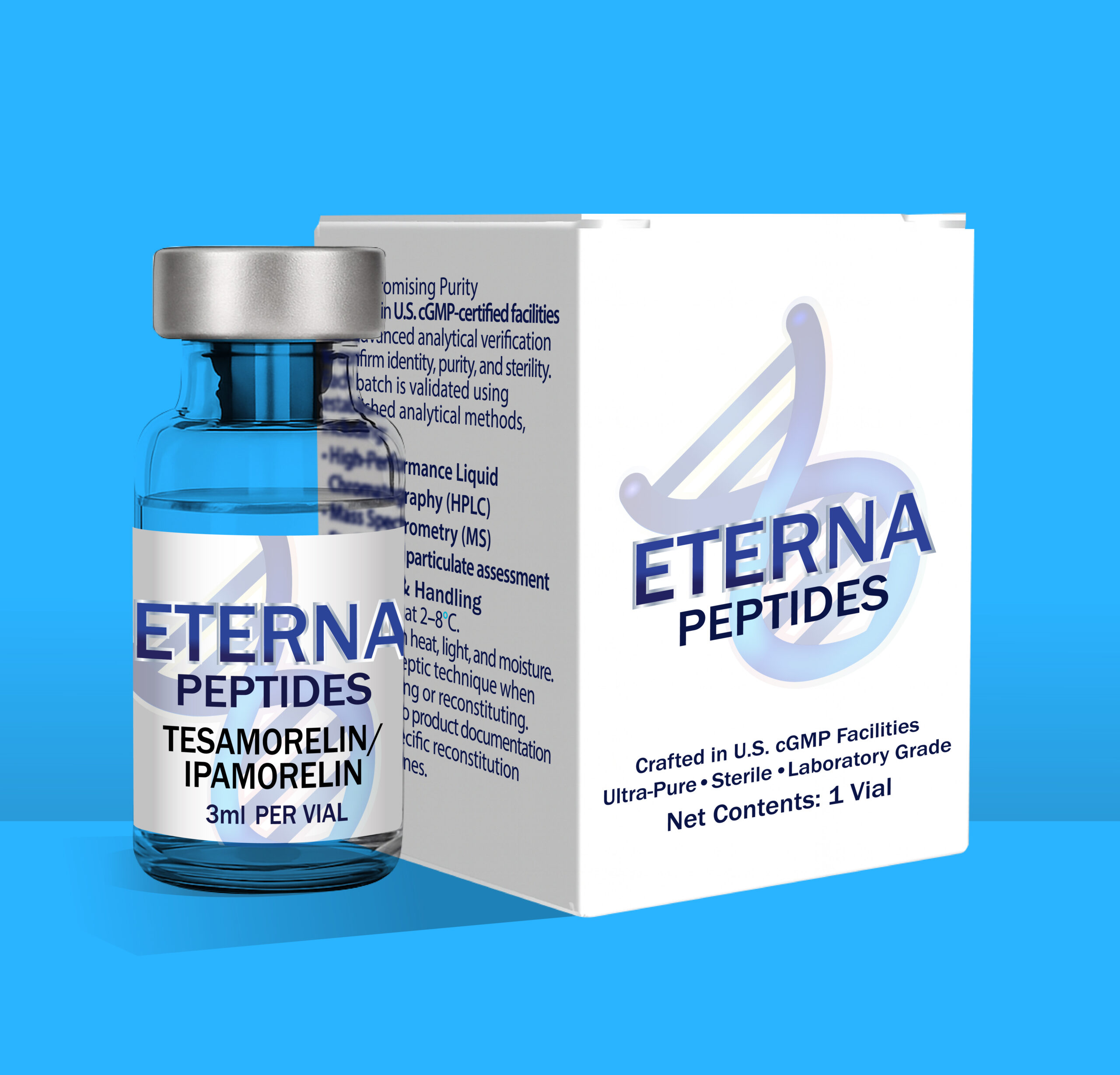
This profile summarizes a research-only co-administration concept pairing tesamorelin (a stabilized 44–amino-acid GHRH analogue) with ipamorelin (a selective ghrelin/GHSR-1a agonist). Tesamorelin activates the pituitary GHRH receptor (GHRHR) to increase pulsatile growth hormone (GH) release and raise IGF-1. Ipamorelin mimics endogenous ghrelin signaling at GHSR-1a to stimulate somatotrophs with minimal ACTH/cortisol activation compared with earlier GHRPs. Physiologically, GHRH and ghrelin pathways are complementary; in experimental settings, combining a GHRH analogue with a GHSR agonist can augment GH pulse amplitude and secretory responsiveness. This document provides neutral background for laboratory discussion and does not imply clinical use.
Chemical Structure / Identifiers — Tesamorelin
| Property |
Detail |
| Class/Target |
GHRH analogue; agonist at GHRH receptor (GHRHR) |
| Length / Modification |
44 amino acids; N-terminal trans‑3‑hexenoyl on Tyr¹ for DPP‑IV resistance |
| Molecular Formula (free base) |
C221H366N72O67S |
| Approx. Molecular Weight |
≈ 5131 g/mol (varies with salt/hydration) |
| CAS Number |
218949‑48‑5 (tesamorelin); 901758‑09‑6 (tesamorelin acetate) |
| PubChem CID |
16137828 |
| Synonyms |
TH9507; INN tesamorelin; tesamorelin acetate (salt) |
Chemical Structure / Identifiers — Ipamorelin
| Property |
Detail |
| Sequence (pentapeptide) |
Aib‑His‑D‑2‑Nal‑D‑Phe‑Lys‑NH₂ (Aib = aminoisobutyric acid; D‑2‑Nal = D‑2‑naphthylalanine) |
| Molecular Formula (free base) |
C38H49N9O5 |
| Molecular Weight (free base) |
≈ 711.85 g/mol |
| CAS Number |
170851‑70‑4 |
| PubChem CID |
9831659 |
| Primary Target |
GHSR‑1a (ghrelin receptor) |
| Synonyms |
Ipamorelin; ipamorelin acetate (salt) |
Primary Research Focus (Combined Rationale)
• Endocrine synergy (physiology): GHRH (tesamorelin) and ghrelin/GHSR agonism (ipamorelin) act via distinct, complementary receptors to enhance GH pulse amplitude and frequency; combination regimens in experimental settings may yield larger acute GH peaks than either agent alone.
• Body composition & metabolism: tesamorelin reduces visceral adipose tissue in HIV‑associated lipodystrophy; ipamorelin selectively elevates GH with minimal ACTH/cortisol activation compared with older GHRPs. Research interest centers on recovery, lean mass support, and metabolic endpoints.
• Mechanistic selectivity: ipamorelin shows limited off‑target endocrine effects at GH‑active doses in preclinical studies; tesamorelin engages the physiologic GHRH axis and secondarily raises IGF‑1.
Safety / Limitations
• Investigational pairing: no established clinical indication for combined tesamorelin + ipamorelin; evidence for additive benefits is mostly physiological and preclinical.
• Tesamorelin class warnings: may worsen glucose intolerance; monitor fasting glucose/HbA1c; avoid in active malignancy; monitor IGF‑1 elevations; common reactions include injection‑site events, arthralgia, myalgia, edema, and nausea.
• Ipamorelin: adverse events reported include nausea, flushing, headache, injection‑site reactions; generally minimal ACTH/cortisol effects versus older GHRPs, but endocrine responses are dose‑ and context‑dependent.
• Research Use Only: not approved for diagnosis, treatment, or prevention of disease; quality and identity must be verified for any laboratory work.
Key Publications / References
FDA Prescribing Information: Tesamorelin (EGRIFTA SV). https://www.egriftasv.com/documents/Prescribing-Information.pdf
PubChem Compound Summary: Tesamorelin (CID 16137828). https://pubchem.ncbi.nlm.nih.gov/compound/16137828
Ferdinandi ES et al. Nonclinical pharmacology and safety of TH9507 (tesamorelin), a stabilized GHRH analogue. Regul Toxicol Pharmacol. 2007. PubMed: https://pubmed.ncbi.nlm.nih.gov/17214611/
Raun K et al. Ipamorelin, the first selective growth hormone secretagogue. Eur J Endocrinol. 1998. PubMed: https://pubmed.ncbi.nlm.nih.gov/9849822/
PubChem Compound Summary: Ipamorelin (CID 9831659). https://pubchem.ncbi.nlm.nih.gov/compound/Ipamorelin
Bowers CY. Growth hormone-releasing peptide (GHRP) and growth hormone secretagogue receptor (GHS-R). Endocrine. 2001 (synergy with GHRH discussed). PubMed: https://pubmed.ncbi.nlm.nih.gov/11767995/
Ghigo E et al. Endocrine and metabolic actions of GH secretagogues: interaction with GHRH. Clin Endocrinol (Oxf). 1996/1997 reviews. PubMed: https://pubmed.ncbi.nlm.nih.gov/9012467/
Disclaimer: For research background only. Not medical advice. Combined use of tesamorelin and ipamorelin is investigational; safety and efficacy for any clinical purpose have not been established.

Reviews
There are no reviews yet.