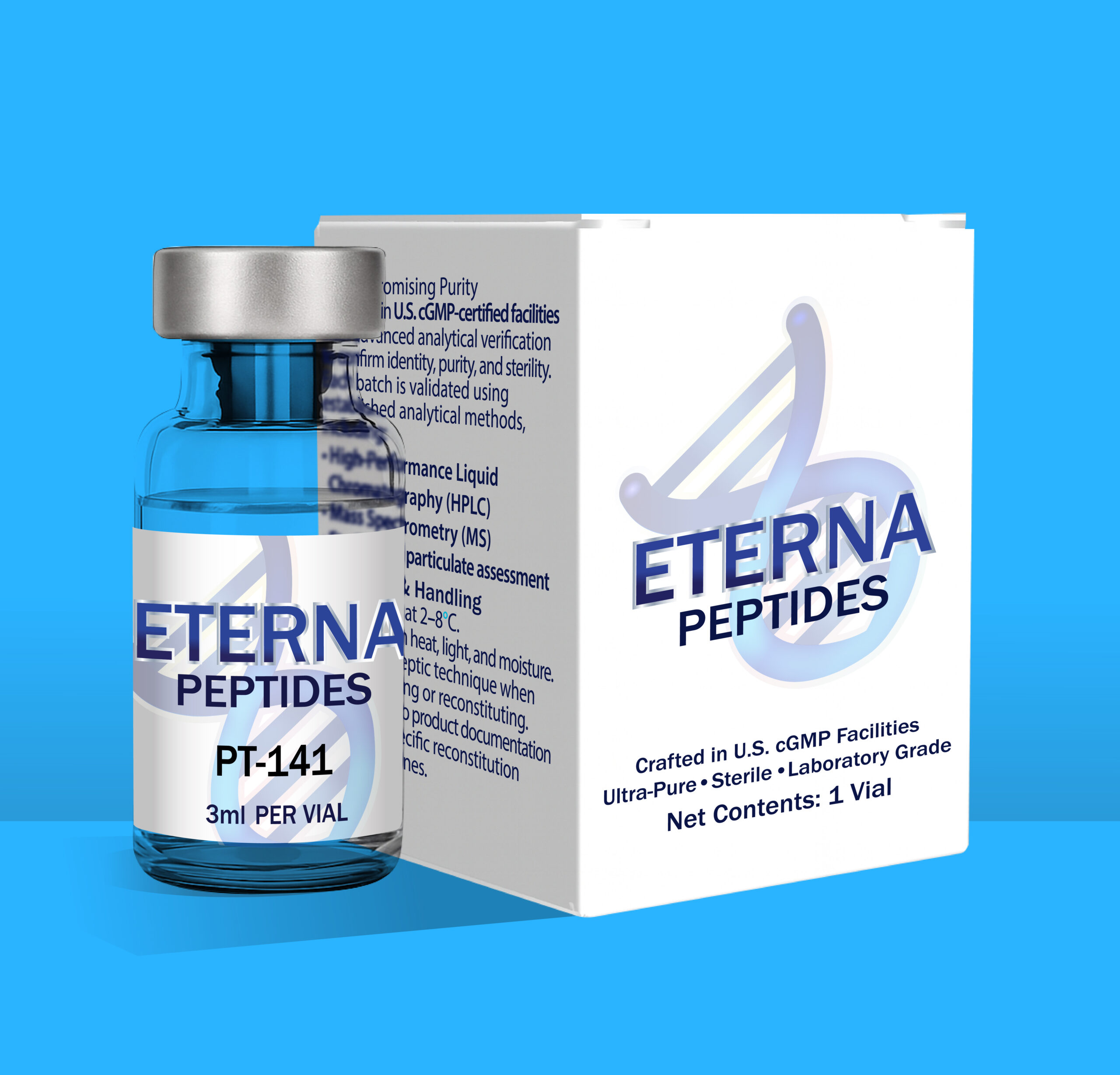
PT‑141, also known as bremelanotide, is a synthetic cyclic heptapeptide and melanocortin receptor agonist derived from the α‑MSH analog melanotan‑II. Unlike melanotan‑II, PT‑141 carries a free acid at the C‑terminus. It engages central melanocortin receptors (notably MC4R and MC3R) implicated in sexual arousal and has been studied in human and preclinical models of sexual dysfunction. An FDA‑approved formulation of bremelanotide (tradename Vyleesi) exists for a specific women’s sexual health indication; the research profile below summarizes the compound’s properties without vendor branding.
Chemical Structure / Identifiers
| Property |
Detail |
| Sequence |
Ac‑Nle‑cyclo[Asp‑His‑D‑Phe‑Arg‑Trp‑Lys]‑OH (cyclic lactam between Asp and Lys) |
| Class/Targets |
Melanocortin receptor agonist; MC1R, MC3R, MC4R, MC5R (MC4R most relevant centrally) |
| Molecular Formula (free base) |
C50H68N14O10 |
| Molecular Weight (free base) |
≈ 1025.2 g/mol |
| CAS Number |
189691‑06‑3 |
| PubChem CID |
9941379 |
| Synonyms |
Bremelanotide; PT‑141; USAN bremelanotide acetate (salt) |
Primary Research Focus
• Sexual function research: central MC4R/MC3R activation linked to increased sexual desire/arousal in preclinical and human studies.
• Mechanistic endocrinology: engages the central melanocortin pathway rather than peripheral vasodilation; distinct from PDE‑5 mechanisms.
• Pigmentation/photobiology (off‑target via MC1R): melanocortin activity can induce cutaneous pigmentation and changes in nevi.
• Appetite/energy homeostasis: melanocortin signaling intersects with energy balance in animal models.
Safety / Limitations
• Common adverse effects in clinical use include nausea, flushing, headache, and injection‑site reactions; hyperpigmentation of skin and gums can occur.
• Transient increases in blood pressure with concurrent small decreases in heart rate have been observed after dosing.
• Use during pregnancy is not recommended; some populations (severe renal/hepatic impairment) may have higher adverse‑event incidence.
• Research Use Only statements apply outside of approved indications; long‑term safety in non‑approved contexts remains limited.
Key Publications / References
FDA Prescribing Information (2019): Vyleesi (bremelanotide) label: https://www.accessdata.fda.gov/drugsatfda_docs/label/2019/210557s000lbl.pdf
FDA Multidiscipline Review (2019): Clinical pharmacology and safety: https://www.accessdata.fda.gov/drugsatfda_docs/nda/2019/210557Orig1s000MultidisciplineR.pdf
PubChem Compound Summary: Bremelanotide (CID 9941379): https://pubchem.ncbi.nlm.nih.gov/compound/9941379
DrugBank: Bremelanotide (DB11653): https://go.drugbank.com/drugs/DB11653
Molinoff PB et al. PT‑141: a melanocortin agonist for the treatment of sexual dysfunction. Ann N Y Acad Sci. 2003;994:96‑102. https://doi.org/10.1111/j.1749-6632.2003.tb03167.x
King SH et al. Melanocortin receptors, melanotropic peptides and penile erection physiology (review). https://pmc.ncbi.nlm.nih.gov/articles/PMC2694735/

Reviews
There are no reviews yet.