Description
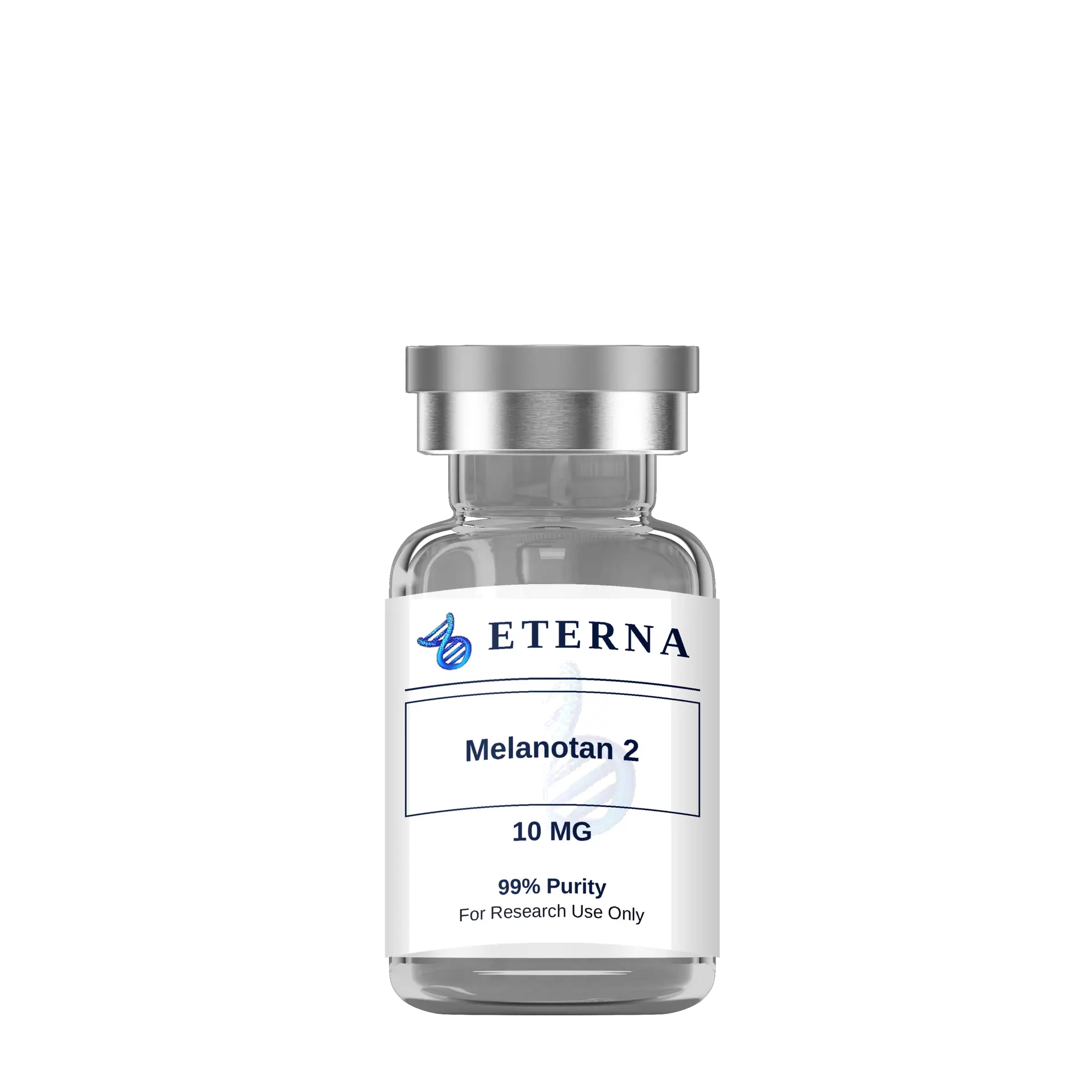
Eterna Peptides presents premium-grade Melanotan II (10mg) lyophilized powder, an advanced synthetic cyclic heptapeptide analogue of the endogenous alpha-melanocyte stimulating hormone (α-MSH). Extensively investigated within molecular biology and dermatology, Melanotan II stands as a powerful investigative tool for exploring the kinetics of melanogenesis, central nervous system neurotransmitter signaling, and the activation curves of the systemic melanocortin receptor network.
### Mechanism of Action
Melanotan II operates as a non-selective, high-affinity agonist across multiple distinct melanocortin receptor subtypes:
* **Melanogenesis Induction (MC1R):** By binding directly to Melanocortin Receptor 1 (MC1R) on structural melanocytes, the peptide triggers an intracellular cyclic AMP (cAMP) cascade. This signaling pathway upregulates tyrosinase activity, driving the enzymatic synthesis and systemic distribution of eumelanin (dark brown pigment) within epidermal cells.
* **Neurological Aphrodisiac Cascades (MC3R & MC4R):** Beyond skin matrices, Melanotan II crosses specialized blood-brain boundaries to interface with central MC3 and MC4 receptors localized in the hypothalamus. This interaction is actively monitored for its capacity to stimulate central nervous system arousal signaling and modulate erectile pathways.
* **Energy Homeostasis and Satiety (MC4R):** Activation of hypothalamic MC4R pathways is heavily investigated for its role in altering metabolic rate regulation, tracking the suppression of food-seeking behaviors, and exploring lipid mobilization kinetics.
### Research Applications
In preclinical and in vitro laboratory models, Melanotan II 10mg vials are actively utilized to investigate:
* Advanced dermatological cell tracking, cellular photo-protection mechanics, and ultraviolet (UV) radiation resistance modeling.
* Central nervous system arousal pathways, hypothalamic signaling cascades, and erectile behavior mechanics.
* Metabolic homeostatic curves, appetite-suppression kinetics, and nutrient repartitioning behavior.
* The comparative baseline potency, binding affinity profiles, and molecular stability of synthetic alpha-MSH variants.
Our Melanotan II vials undergo strict laboratory stabilization, vacuum-drying, and purification guidelines to ensure absolute peptide chain integrity, rapid reconstitution kinetics, and dependable experimental reproducibility.
—
*Disclaimer: This product is sold strictly for laboratory research and development use only. It is not intended for human consumption, diagnostic, or therapeutic purposes.*