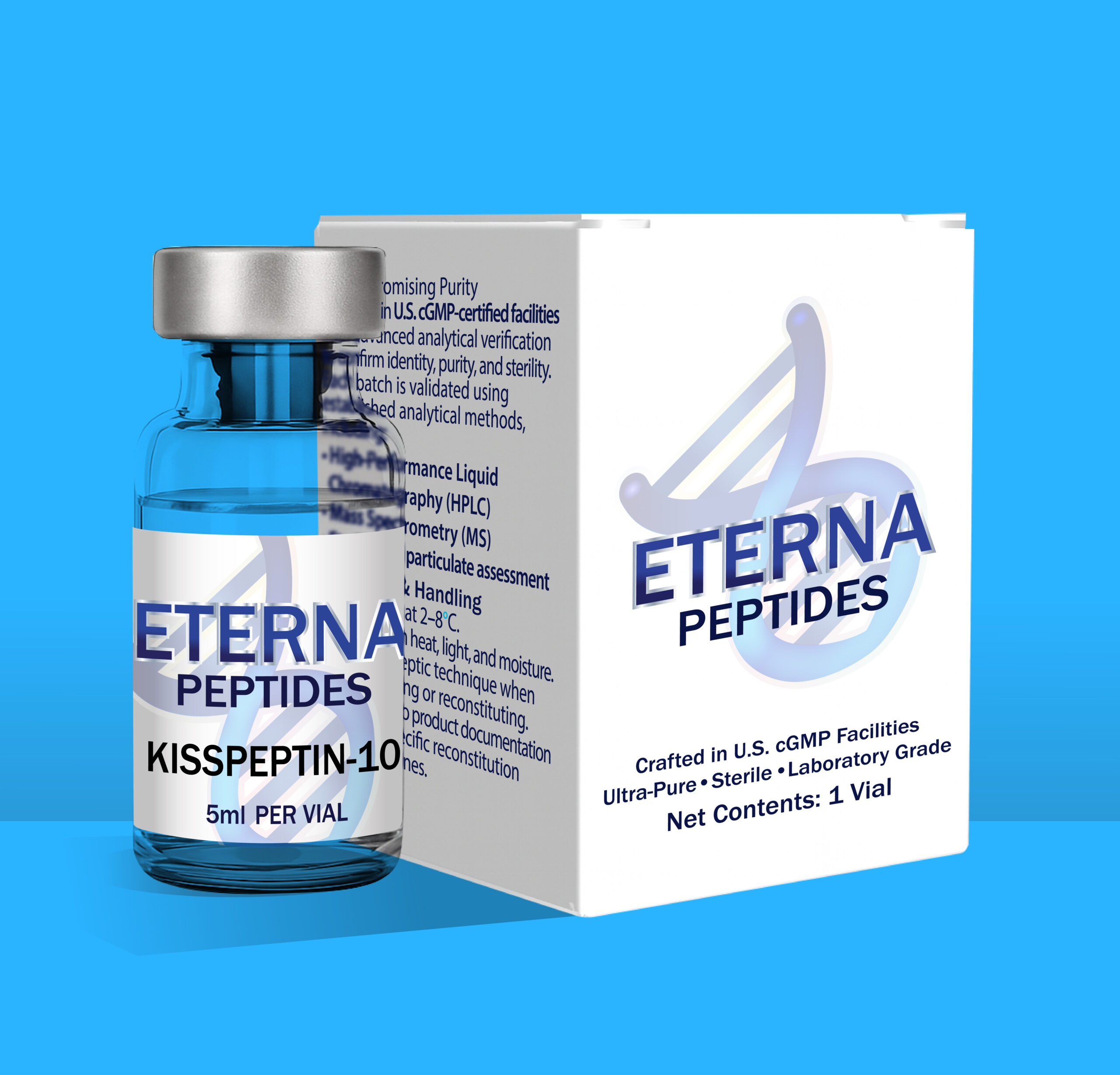
Kisspeptin-10 (KP-10) is a decapeptide fragment of the KISS1 gene product that acts as an endogenous ligand at the kisspeptin receptor (KISS1R/GPR54). KP-10 potently stimulates hypothalamic gonadotropin-releasing hormone (GnRH) secretion, thereby activating the hypothalamic–pituitary–gonadal (HPG) axis. The peptide has been investigated for roles in reproductive endocrinology, puberty initiation, fertility modulation, and tumor biology.
Chemical Structure / Identifiers
| Property |
Detail |
| Sequence |
H–Tyr–Asn–Trp–Asn–Ser–Phe–Gly–Leu–Arg–Fhe–NH₂ (KP-10) |
| Molecular Formula |
C63H83N17O14 (PubChem CID 25240297) |
| CAS Number |
374675-21-5 (IUPHAR/British Pharmacological Society Guide to Pharmacology) |
| PubChem CID |
25240297 (Kisspeptin-10) |
| Synonyms |
KP-10; Kisspeptin (45–54); Metastin 45–54; Kisspeptin decapeptide |
Primary Research Focus
• Reproductive axis activation: KP-10 stimulates GnRH release, increasing LH and testosterone secretion in humans and animal models.
• Puberty and fertility research: central in timing of puberty and regulation of ovulation/spermatogenesis.
• Oncology/angiogenesis: KP-10 has been reported to inhibit VEGF-driven angiogenesis and tumor growth in preclinical models.
• Neuroendocrine signaling: integrates with neurokinin B and dynorphin neurons in the arcuate nucleus to regulate GnRH pulsatility.
Safety / Limitations
• Human studies show acute endocrine responses, but long-term safety/efficacy data are limited.
• Effects can be dose- and route-dependent; tachyphylaxis has been described with continuous infusion.
• Research Use Only; not approved for diagnosis, treatment, or prevention of disease.
Key Publications / References
PubChem Compound Summary: Kisspeptin-10 (CID 25240297). https://pubchem.ncbi.nlm.nih.gov/compound/25240297
IUPHAR/BPS Guide to Pharmacology: kisspeptin-10 ligand page (CAS 374675-21-5; synonyms). https://www.guidetopharmacology.org/GRAC/LigandDisplayForward?ligandId=1283
Comprehensive review of kisspeptin in reproduction: Clarke et al., 2015. https://pmc.ncbi.nlm.nih.gov/articles/PMC4508256/
Clinical physiology: Kisspeptin-10 stimulates LH/testosterone in men, George et al., 2011. https://pmc.ncbi.nlm.nih.gov/articles/PMC3380939/
Mechanistic review: Kisspeptin–GnRH pathway and HPG control, Skorupskaite et al., 2014. https://pmc.ncbi.nlm.nih.gov/articles/PMC4063702/
Additional overview: Frontiers in Endocrinology 2022 review on kisspeptin–KISS1R signaling. https://www.frontiersin.org/articles/10.3389/fendo.2022.925206/full

Reviews
There are no reviews yet.