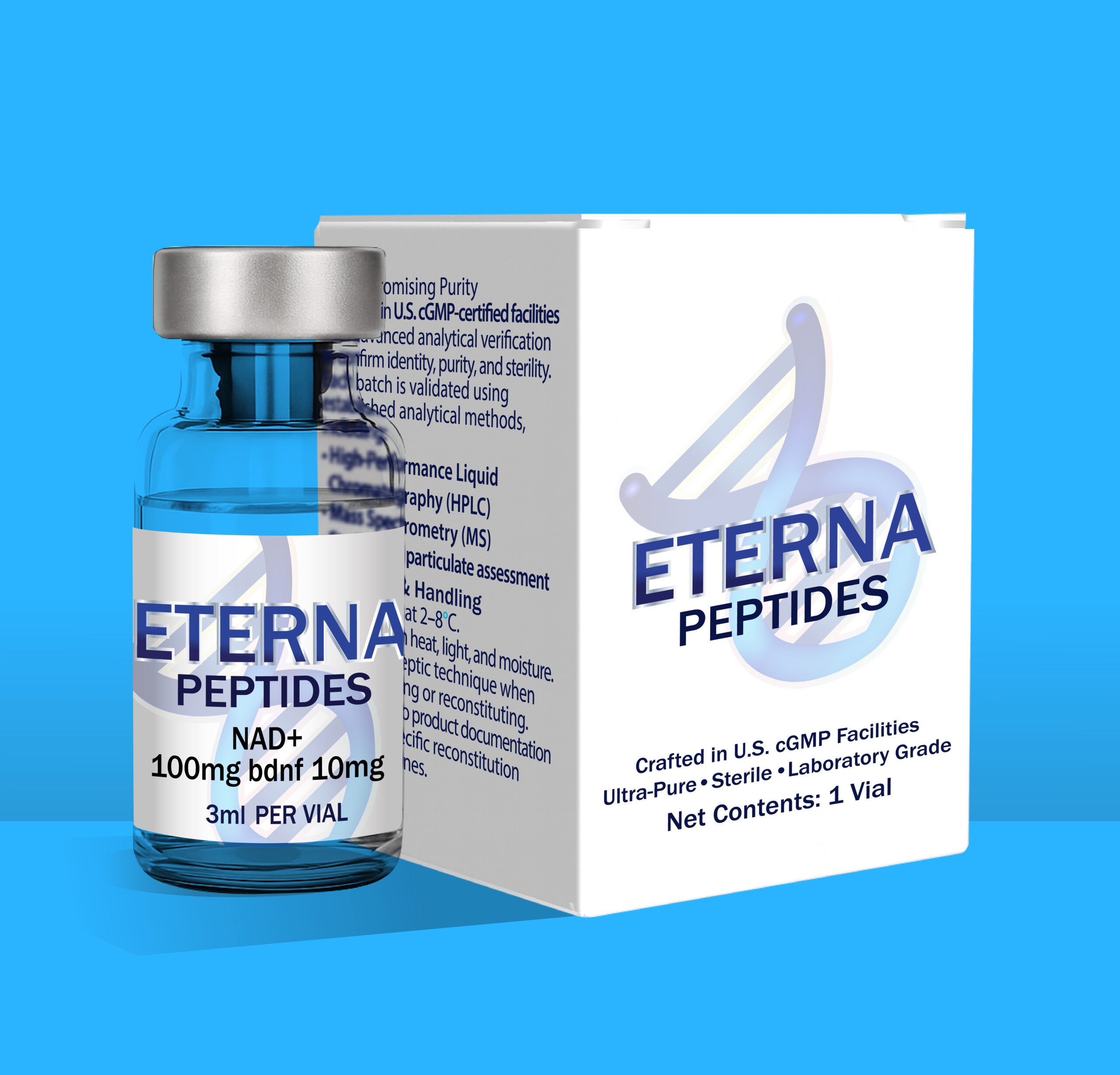
This profile summarizes a research-only co-formulation concept combining NAD+ (nicotinamide adenine dinucleotide, oxidized form) with BDNF (brain-derived neurotrophic factor). The rationale pairs a ubiquitous cellular redox coenzyme (NAD+) with a neurotrophin (BDNF) that regulates neuronal survival, synaptic plasticity, and neurogenesis via TrkB (NTRK2) signaling. This document provides neutral background for laboratory discussion and does not imply clinical use.
Chemical Structure / Identifiers — NAD+
| Property |
Detail |
| Preferred Name |
β‑Nicotinamide adenine dinucleotide (oxidized form); NAD+ |
| Synonyms |
Diphosphopyridine nucleotide (DPN); Coenzyme I; Nadide |
| Molecular Formula (anhydrous) |
C21H27N7O14P2 |
| Molecular Weight (anhydrous) |
≈ 663.43 g/mol |
| CAS Number |
53‑84‑9 |
| PubChem CID |
925 (β‑NAD) |
Chemical Structure / Identifiers — BDNF
| Property |
Detail |
| Protein Class |
Neurotrophin family growth factor; endogenous human protein |
| Gene / Receptor |
BDNF gene; primary receptor TrkB (NTRK2) |
| Mature Peptide |
119 amino acids (derived from proBDNF ~247 aa); typically exists as a homodimer (~26–28 kDa) |
| UniProt |
P23560 (human BDNF) |
| NCBI Gene |
Gene ID: 627 (human BDNF) |
| Notable Features |
Regulates neuronal survival, synaptogenesis, and long-term potentiation via TrkB signaling |
Primary Research Focus
• NAD+: central electron carrier in glycolysis, TCA cycle, and oxidative phosphorylation; co‑substrate for sirtuins (SIRT1‑7), PARPs, and CD38/CD157 with roles in DNA repair, chromatin remodeling, circadian biology, and immune signaling.
• BDNF: promotes neuronal survival and differentiation; essential for synaptic plasticity, learning and memory; modulates neurogenesis and dendritic spine dynamics via TrkB (NTRK2) signaling cascades (MAPK/ERK, PI3K/AKT, PLCγ).
• Complementary hypothesis (preclinical rationale): cellular energetic capacity and redox state (NAD+) influence neuronal stress responses, while BDNF/TrkB signaling drives plasticity; co‑discussion appears in neuroprotection and healthy‑aging research contexts.
Safety / Limitations
• Research Use Only. This is a background profile, not a therapeutic recommendation.
• NAD+ augmentation in humans shows mixed, mostly short‑term effects; optimal dosing, long‑term efficacy and safety remain under investigation.
• BDNF is a large protein with limited blood–brain barrier penetration; systemic administration shows poor CNS exposure. Experimental delivery approaches include intranasal administration, ex vivo gene delivery, viral vectors, or small‑molecule TrkB agonists. Immunogenicity and off‑target effects are considerations for recombinant proteins.
• No established evidence that co‑administration of NAD+ and BDNF is clinically beneficial; any synergy is hypothetical and model‑dependent.
Key Publications / References
PubChem Compound Summary: β‑Nicotinamide adenine dinucleotide (CID 925). https://pubchem.ncbi.nlm.nih.gov/compound/925
Covarrubias AJ et al. NAD+ metabolism in cellular processes during aging. Nat Rev Mol Cell Biol. 2021. PMC: https://pmc.ncbi.nlm.nih.gov/articles/PMC7963035/
Katsyuba E, Auwerx J. NAD+ homeostasis in health and disease. Nat Rev Mol Cell Biol. 2020. https://europepmc.org/article/med/32694684
UniProtKB: Human BDNF (P23560). https://www.uniprot.org/uniprotkb/P23560/entry
Huang EJ, Reichardt LF. Trk receptors: roles in neuronal signal transduction. Annu Rev Biochem. 2003. https://pubmed.ncbi.nlm.nih.gov/14527315/
Park H, Poo MM. Neurotrophin regulation of neural circuit development and function. Nat Rev Neurosci. 2013. https://pubmed.ncbi.nlm.nih.gov/24049345/
Lu B et al. BDNF and synaptic plasticity, cognition, and diseases. Neuron. 2013. https://pubmed.ncbi.nlm.nih.gov/25233318/
Thorne RG et al. Intranasal delivery of CNS therapeutics. Adv Drug Deliv Rev. 2004. https://pubmed.ncbi.nlm.nih.gov/15191767/
Nagahara AH, Tuszynski MH. Potential therapeutic uses of BDNF in neurological and psychiatric disorders. Nat Rev Drug Discov. 2011. https://pubmed.ncbi.nlm.nih.gov/21468040/
Disclaimer: For laboratory research background only. Not medical advice. NAD+ and BDNF are not approved together as a therapy; safety and efficacy for any combined use have not been established.

Reviews
There are no reviews yet.